


A letterman jacket frame needs a deep shadow box, typically with 3 to 6 inches of interior depth, acid-free backing, and mounting that supports the shoulders without crushing the wool or creasing the sleeves. A flat picture frame isn't built for the jacket's weight, bulk, or combination of wool, leather, lining, patches, and metal hardware.
The impulse is understandable. You've found the jacket at the back of a closet, or you're preparing a graduation keepsake, and a standard frame appears to offer the simplest way to get it onto the wall. But a varsity jacket is a shaped garment, not a poster. Its shoulders need room, its sleeves need controlled support, and its materials need protection from light and direct contact.
The right display is part presentation and part conservation. By the end, your decisions should be clear: choose enough depth, support the garment's structure, and use glazing that limits exposure to damaging light.
Table of Contents
- Why Framing a Letterman Jacket Is Different From Other Apparel
- Choosing the Right Frame Type for a Full Jacket
- Frame Materials and Conservation Basics
- Mounting and Shaping the Jacket Inside the Frame
- Real Display Setups and Styling the Result
- Long-Term Care and Maintenance Checklist
Why Framing a Letterman Jacket Is Different From Other Apparel
A standard picture frame fails first because it's too shallow. A letterman jacket has a structured body, thick ribbing, a lining, chenille patches, and often leather or leather-like sleeves. The shoulders and sleeve heads create three-dimensional bulk that won't flatten safely against a backing board.
The material combination creates a second problem. Wool and leather don't respond identically to pressure, humidity, or light, while snaps, zippers, and embroidered patches add hard points that can press into the fabric. A frame that looks closed and tidy on the worktable may be forcing the jacket into a permanent crease once it's hung.
The history helps explain why the garment has this visual weight. The letterman tradition traces to Harvard in 1865, when the baseball team used large embroidered “H” letters to identify top players. By the 1890s, the practice had moved beyond the field, and by 1930 the familiar combination of wool body, leather sleeves, and chenille lettering had emerged, as documented in this history of letterman jacket development. That isn't just nostalgia. It explains why the jacket's silhouette, contrast sleeves, and prominent lettering deserve to remain visible rather than compressed.
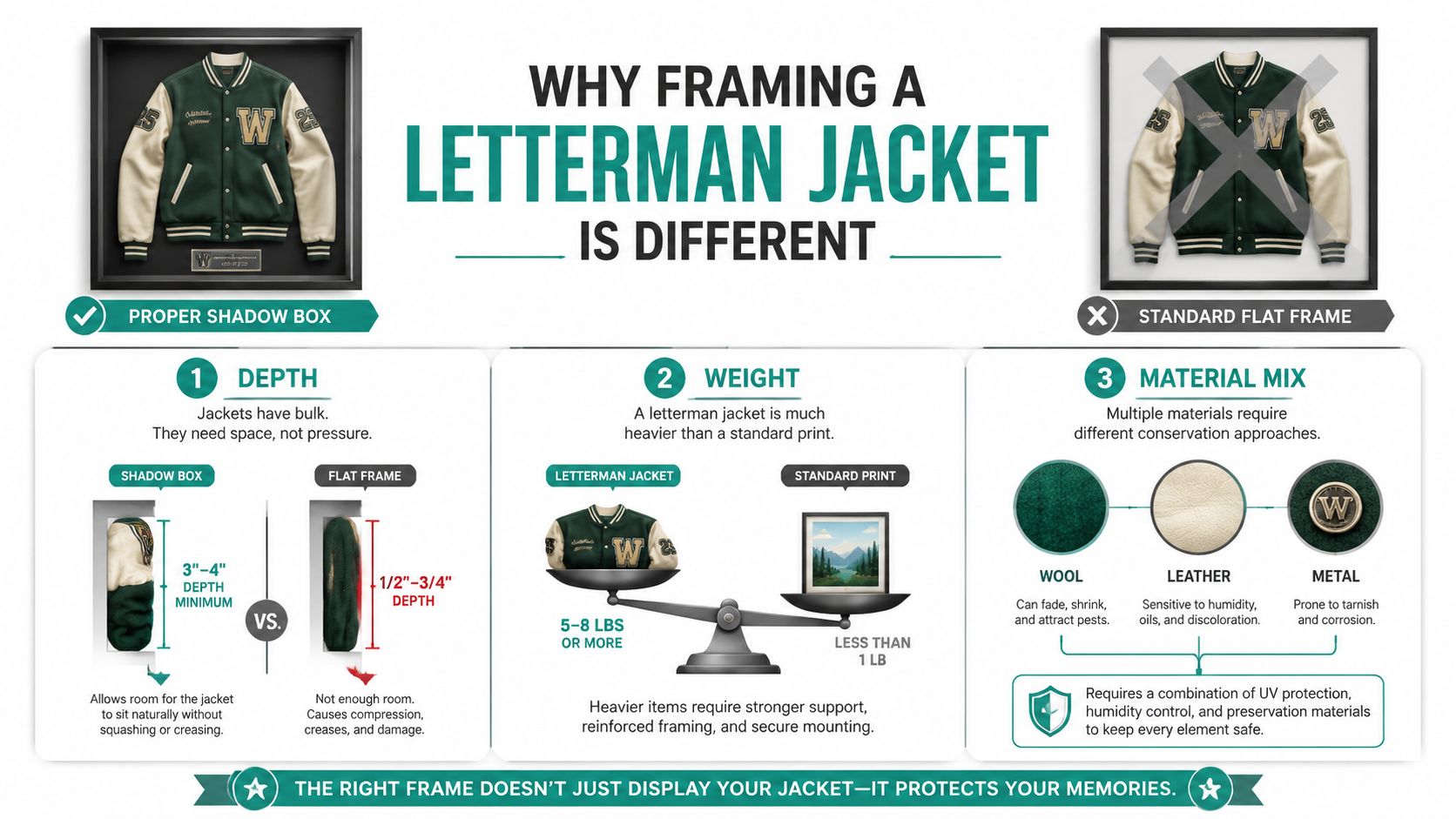
The three problems a flat frame creates
- Depth: The jacket needs air space around its shoulders, sleeves, and patches. A shallow frame presses those parts against the glazing.
- Weight: A jacket places far more load on the mounting system than a paper print or lightweight shirt.
- Material mix: Wool, leather, chenille, lining, thread, and metal closures need different handling.
A jersey can often be folded or stitched relatively flat inside a shadow box. A letterman jacket needs its form preserved. Even when shopping for a new garment, such as a heavyweight letterman jacket, assess the body and sleeve construction before choosing a display enclosure.
Practical rule: If the shoulder support feels compressed before the glazing is installed, the frame is too shallow or the mounting is too aggressive.
Choosing the Right Frame Type for a Full Jacket
Three enclosure styles make sense for a full jacket. They differ less in appearance than in how much freedom they give the garment to occupy space.
| Frame Type | Interior Depth Needed | Best For | Trade-Off |
|---|---|---|---|
| Deep shadow box | 3 to 6 inches | Most full jackets, especially those with patches and structured sleeves | Clean, wall-mounted presentation, but custom sizing is usually necessary |
| Traditional wide-lip frame with mounting board | Deep enough to clear the shoulders | Lightweight jackets with restrained shaping | More familiar and potentially less costly, but compression remains a risk |
| Freestanding display cabinet behind acrylic | Flexible, often substantially deeper | Jackets you still want to handle, pose, or reconfigure | Excellent three-dimensional presentation, but it takes more floor or wall space and can collect dust |
A 3-inch interior can work for a relatively lightweight jacket mounted on a shaped hanger form, provided the shoulders aren't overfilled. A padded jacket with thick patches, substantial ribbing, or stiff leather sleeves is more comfortable in the 4 to 6-inch range. Those depth benchmarks align with the practical need for air space and with deep cabinet-style shadow boxes recommended for bulky apparel displays, as shown by this extra-deep jacket and uniform display case.
The deep shadow box is the default choice for most owners. It keeps the jacket on the wall, presents the front cleanly, and gives you enough room to shape the sleeves instead of folding them into a narrow rectangle. The drawback is that sizing has to be accurate. Measure the jacket in its intended display position, not while it's crushed flat on a table.
A traditional frame with a broad lip can be tempting, especially for a decorative project. It works only when the mounting board and frame cavity leave genuine clearance. If the body bows outward and touches the glazing, the frame is acting as a press, not a display case.
A cabinet is best when the jacket remains part of a collection that changes. You can pose it on a torso form, remove it for inspection, or display related objects beside it. That flexibility comes at the cost of dust management and wall space. Browse jacket styles and silhouettes with the eventual display depth in mind, especially if the garment will be worn before it becomes a keepsake.
The frame type determines the enclosure. The backing, glazing, spacers, and supports determine whether the enclosure protects the jacket.
Frame Materials and Conservation Basics
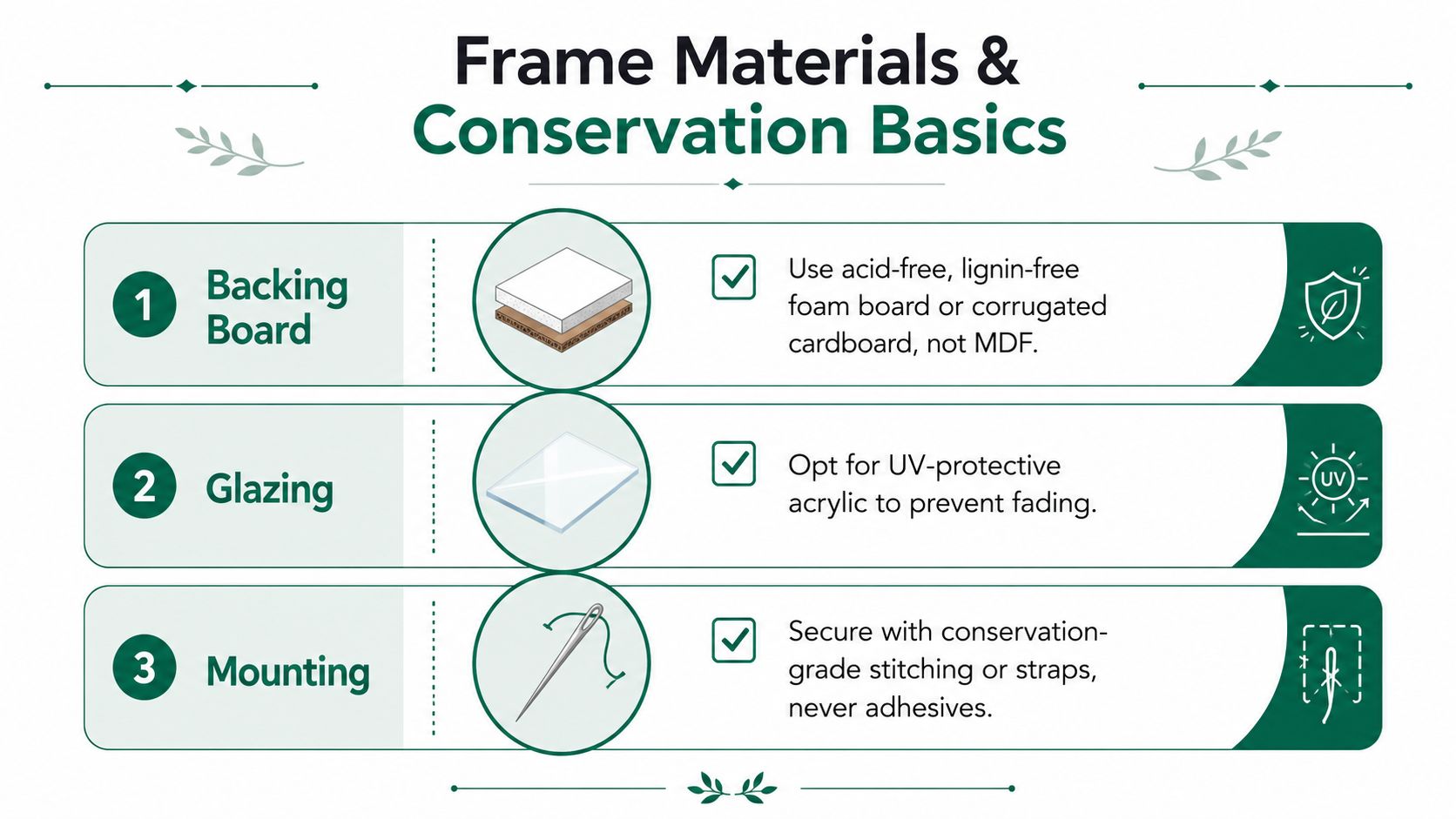
A framer's materials cart starts with the backing, not the moulding. Use acid-free, lignin-free foam board or conservation corrugated cardboard. Regular MDF has no place behind a wool and leather garment because unstable materials can release compounds that discolor nearby textiles and accelerate deterioration.
The jacket should never rest directly against the glazing. Install spacers or a frame liner so the sleeves, chenille letters, and raised seams maintain air space. A deep shadow box only works when its internal clearance matches the jacket's highest points, including shoulder fill and patches.
Build the materials list around support
For shoulder shaping, rolled acid-free tissue provides a gentle internal fill. Ethafoam planks can add back support when cut to the jacket's width and covered with a clean, inert textile. These supports should hold the form, not force the jacket into a fashion-model pose.
Use conservation stitching, T-pins, or stainless steel sewing pins to anchor seams into the backing board. Keep attachment points discreet and place them where the jacket's construction can carry the load. Don't use glue, double-sided tape, or adhesive strips on wool, leather, lining, or chenille. Adhesives can stain, stiffen, and make later removal unnecessarily destructive.
Published varsity-jacket specifications include a 24-ounce wool body, with wool, leather, or naugahyde sleeves, according to this letter-jacket specification sheet. That weight class explains why mounting hardware and seam reinforcement matter. A backing board that works for a flat patch may flex under a complete jacket.
Choose glazing for the garment's future
Standard glass is clear and familiar, but it offers limited protection from ultraviolet exposure unless it has a protective coating. UV-protective acrylic is lighter and safer for a large wall display, while museum acrylic offers improved clarity and anti-static performance at a higher cost. For a signed, vintage, or emotionally irreplaceable jacket, premium glazing is easier to justify. For a decorative modern jacket, a basic deep enclosure with UV protection can be a sensible compromise.
Source the board and pins from a conservation framing supplier, the acrylic from a glazing specialist, and the shadow-box moulding from a framer who handles textiles. Buying each item from the cheapest general craft aisle often creates a mismatched system.
Mounting and Shaping the Jacket Inside the Frame
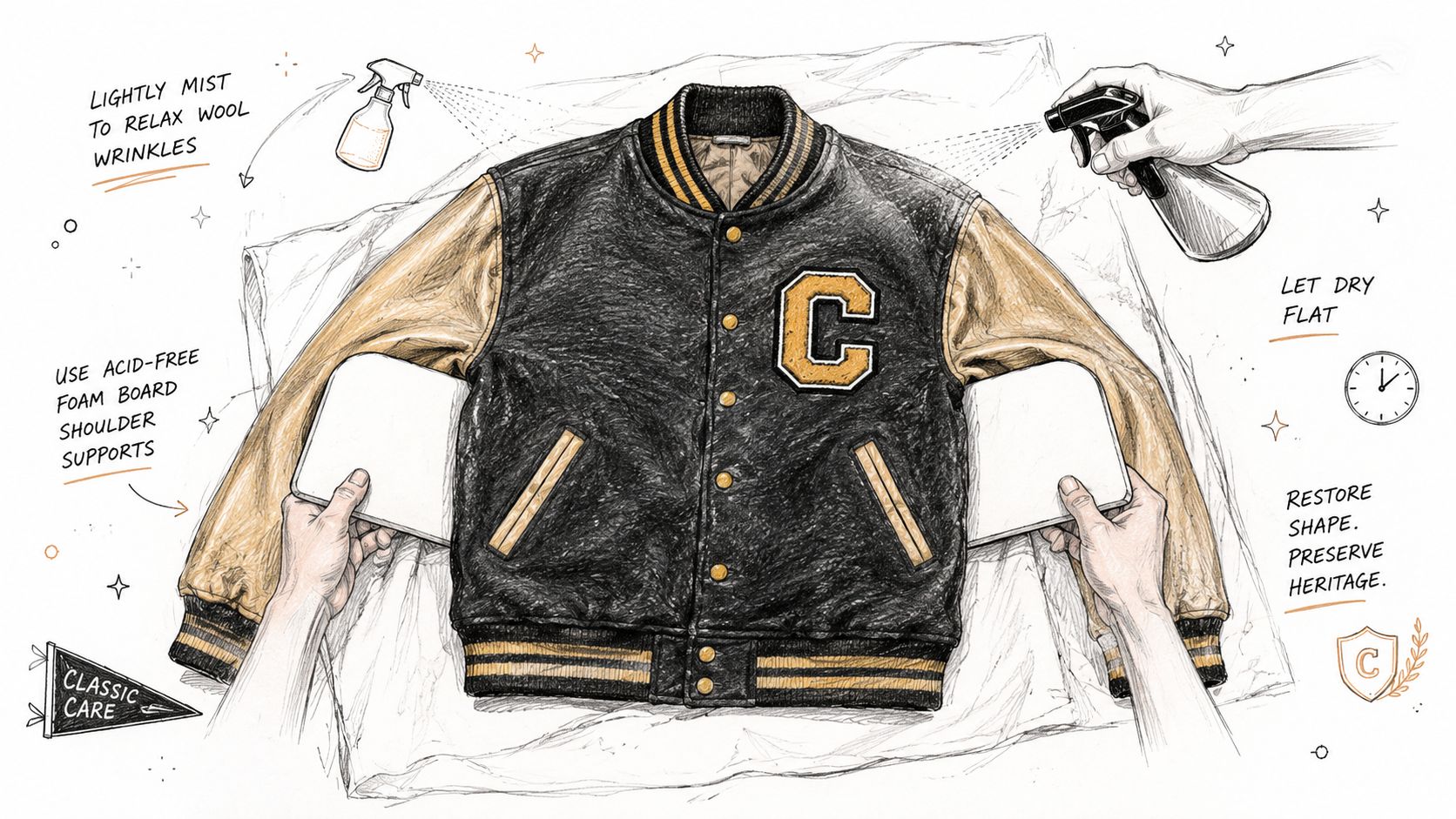
Mounting should preserve the jacket's natural stance without making it look inflated. Work on a clean cotton sheet, close the jacket, and smooth the body with your hands. Don't soak the wool or mist the leather sleeves. If the garment needs serious wrinkle treatment, take it to a textile conservator or a cleaner experienced with mixed-material outerwear.
Start with the shoulders. Roll acid-free cotton batting into two firm supports and place them inside the shoulder areas. The fill should occupy the empty space while allowing the shoulder line to retain its natural slope. If the jacket looks stuffed, remove material. The goal is controlled support, not volume for its own sake.
Establish the body before fixing details
Attach a strip of muslin to the upper edge of the backing board, then pass it through the hanger area or use it as a temporary suspension aid. Let the jacket settle against the backing board briefly before final pinning. This helps gravity reveal where the body wants to sit and exposes twisting that isn't obvious while you're holding it.
Tuck clean polyester fiberfill inside the sleeves to prevent sharp elbow collapse. Arrange each sleeve in a relaxed curve, with the cuffs turned slightly forward so the contrast material and ribbing remain visible. Leather should never be folded tightly for visual symmetry. A gentle curve is safer and looks more like a worn garment.
Use the zipper or button line as a vertical reference. Center that line on the backing board, then check the distance from each shoulder to the frame edge. Secure the collar behind the ribbing with discreet T-pins, and anchor strong seams rather than thin lining. Add further stitching or straps only where the jacket shifts during a dry fit.
Mounting test: Close the empty frame around the mounted jacket before installing the glazing. Look from the side and front. If any patch, sleeve, snap, or shoulder support approaches the glazing, increase the depth or reduce the internal shaping.
Finish by checking the bottom hem and cuffs. They should rest naturally, without a hard horizontal fold. Once the jacket looks balanced, photograph the mounting points before closing the back. That record helps if the frame needs to be opened for inspection later.
Real Display Setups and Styling the Result
A letterman jacket frame can look residential, industrial, or institutional depending on the enclosure and surrounding objects. The jacket itself shouldn't be forced into a rigid pose. Depth and lighting do most of the styling work.
A workshop or garage display
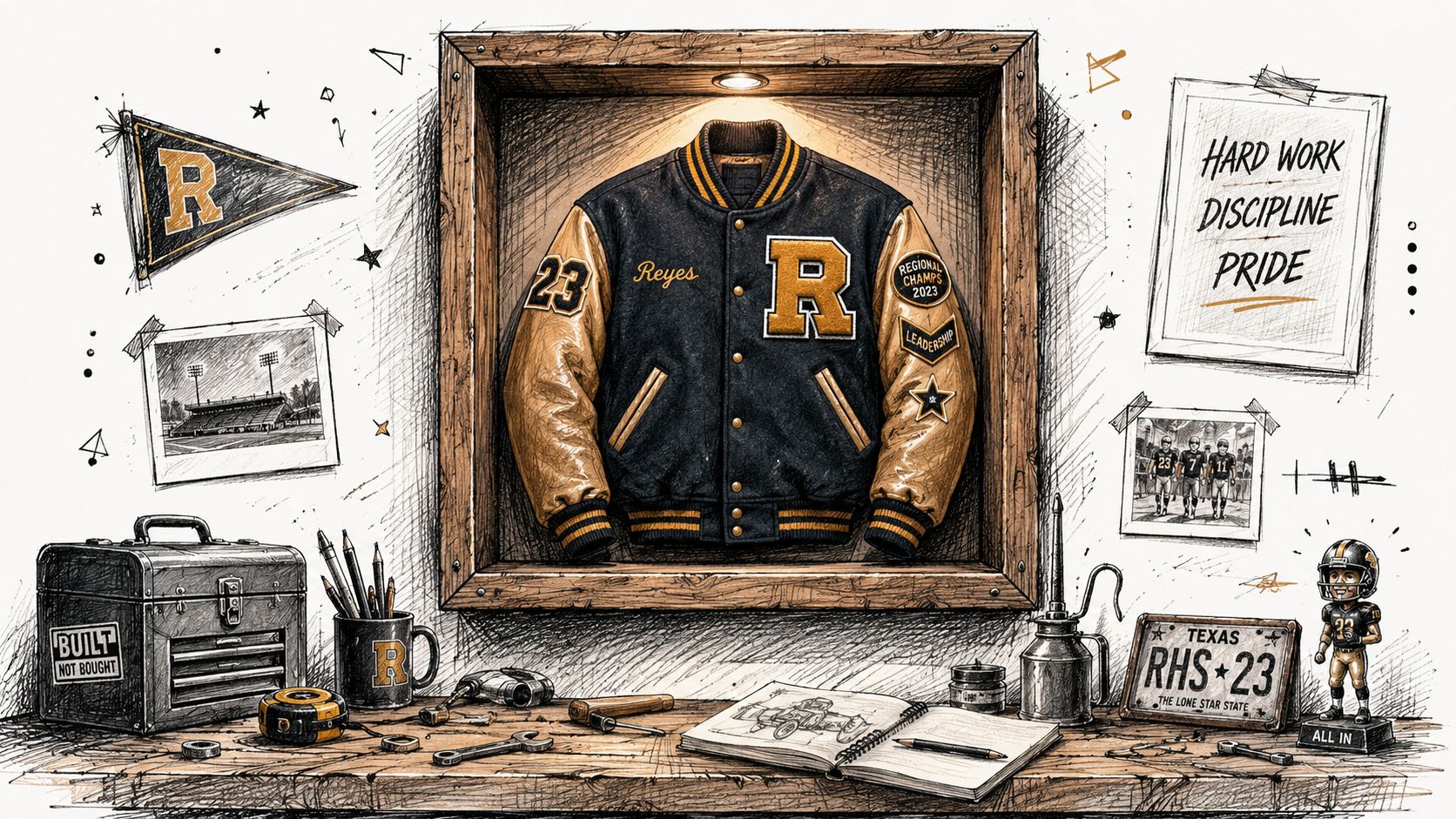
A reclaimed-wood shadow box with a deep cavity suits a garage, studio, or man cave. Mount it at eye level above a workbench, then use a warm LED puck positioned so it washes the jacket rather than shining directly through the glazing. Let the sleeves fall in relaxed curves, and place a vintage helmet or framed team photograph nearby without crowding the jacket.
This setup benefits from visible texture. Wood, wool, leather, and chenille can look intentional together, but dust becomes more noticeable, so choose a cabinet or frame with a dependable rear closure.
A formal living room
For a living room, a black-stained shadow box gives the jacket a quieter outline. Button or zip the jacket, fill the shoulders lightly, and fold the sleeves forward just enough to suggest a body beneath the garment. A small engraved plate with the school and year can add context without competing with the lettering.
Keep nearby decoration restrained. A monochrome arrangement, including carefully selected hoodies elsewhere in the room, can support the display without turning the wall into a retail rack.
A collection or trophy room
A trophy room rewards consistency. Matching deep shadow boxes, aligned at a uniform height, make different jackets feel like one collection. Keep shoulders filled and patches visible, and use LED strip lighting placed outside the direct viewing path so the light doesn't sit on the leather or lettering.
A cabinet is the better choice when the owner wants to remove and handle jackets regularly. For a permanent wall display, the deep shadow box has the cleaner profile and makes accidental handling less likely.
Long-Term Care and Maintenance Checklist
A frame isn't a sealed vault. Wool, leather, thread, and lining still respond to the room around them, and the mounting system can shift over time. Keep this checklist near the storage area and run through it regularly.
- Control the room climate. Aim for a stable environment between 40% and 55% relative humidity, as recommended in the supplied preservation guidance. A basic hygrometer placed near the display can reveal swings before the jacket develops a musty smell or the leather begins to feel brittle.
- Manage light deliberately. Keep direct sunlight away from the frame. Use LED lighting rather than hot lamps, and check the glazing edges occasionally for signs that the protective layer has changed or that the frame has developed a gap.
- Remove dust without touching the textile. Inspect the exterior periodically. If you open the enclosure, use a vacuum with a soft brush attachment held away from the jacket, and clean the frame cavity rather than dragging a tool across wool or chenille.
- Inspect the mounting once a year. Remove the back carefully and look along seams, cuffs, collar, and sleeve joins for moth evidence, mildew odor, loose stitching, or shifted pins. Check the jacket from the side so you can see whether any support has collapsed.
- Refresh the internal supports when needed. Acid-free batting can compress, and fiberfill can settle. Re-mount the jacket when it starts taking a permanent crease or the shoulders lose their intended shape. Conservation guidance favors reversible mounting and minimal intervention, which is one reason a cabinet can be safer than a tightly fitted frame for a highly valuable heirloom.
Maintenance principle: The best letterman jacket frame protects by creating space, limiting light, and allowing inspection. It shouldn't hide problems until restoration becomes urgent.
If the jacket is decorative rather than historically important, a well-built deep shadow box with acid-free backing, sensible UV protection, and a stable room may be enough. Signed, vintage, or irreplaceable pieces deserve a professional textile framing consultation, especially when leather is dry, wool is fragile, or old patches are already lifting.
The goal isn't to make the jacket look untouched. A good display preserves the garment's character while preventing the frame from becoming the source of new damage.
2Ghetto offers limited-run, monochrome streetwear including heavyweight letterman jackets, so you can choose a contemporary piece with a clear display silhouette and documented product details. Visit 2Ghetto to browse the current outerwear and apparel collections, then plan the jacket frame around the garment's actual weight, sleeve structure, and future use.